Each Veterans Day (11/11), Americans pause to honor the men and women who have served in the armed forces. But honoring military service raises a broader question: Should service to one’s country be voluntary, or should every American be expected to contribute in some way?
Recent polling suggests that Americans have mixed views about compulsory service. A 2026 ABC News/Washington Post/Ipsos poll found that 85% of Americans opposed reinstating the military draft. Meanwhile, a 2025 international Ipsos survey found that only 35% of Americans supported mandatory military service for young people, compared with an average of 52% across 30 countries.
But what about young Americans who have already chosen a path toward military service? Do they believe that serving one’s country should be an obligation shared by everyone?
In an earlier post, we examined attitudes toward national service using data collected up to 2021. Here, we turn to more recent survey responses collected between fall 2017 and spring 2026 (N = 4,665), focusing exclusively on ROTC and service academy cadets. We examine their attitudes toward mandatory nonmilitary national service and registration for a potential military draft.
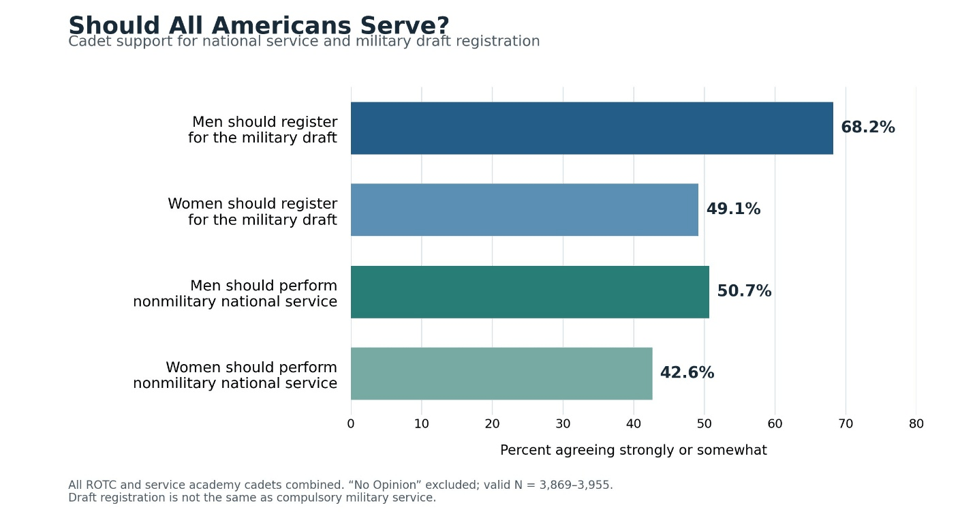
The findings reveal some interesting distinctions. More than two-thirds (68%) of cadets supported requiring men to register for a military draft at age 18. However, support dropped to 49% when the same requirement was applied to women. Importantly, registering for the draft does not necessarily mean being called to military service.
Cadets were less supportive of mandatory nonmilitary national service. Approximately half (51%) supported requiring men to perform some form of national service, while only 43% supported requiring women to do so.
Our findings suggest that even among young people preparing for military careers, there is no clear consensus about requiring Americans to serve. These cadets have chosen a path toward military service, yet many do not favor imposing similar obligations on others. Perhaps some are reluctant to lead individuals who have little desire to serve, although our survey cannot tell us why cadets hold these views.
Perhaps that distinction between choosing to serve and being required to serve is worth reflecting on this Veterans Day. We honor the men and women who have served our country, whether they volunteered or were called to serve. But their service also raises a broader question: What responsibilities do the rest of us have to our country and to those who have served?

