Venezuela, Iran, and Why Support for Military Force Breaks Down

As the United States continues its military involvement with Iran, public opinion shows that many Americans disapprove of the conflict, although clear majorities are not present. For instance, an AP/NORC poll finds that 39% of Americans somewhat or strongly oppose airstrikes in Iran, while 33% approve. Similarly, in Venezuela, a YouGov analysis shows a narrow margin of opposition: about 45% of Americans oppose U.S. military efforts to overthrow President Nicolás Maduro, compared to 40% who support it.

Across cases, the pattern is consistent: some support exists, but it is cautious, conditional, and often declines as missions expand.

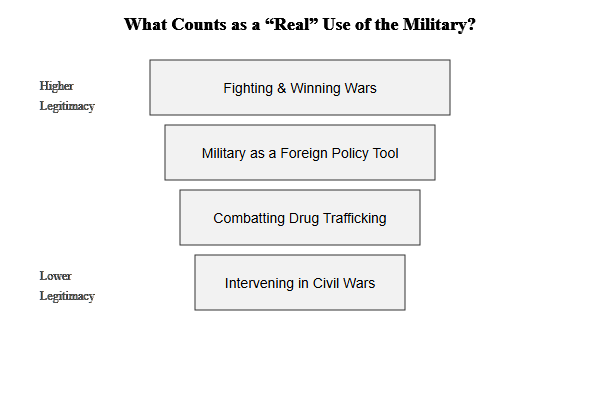
In a previous post, we introduced the idea of a “legitimacy ladder.” This is a way of thinking about how support for military action changes depending on the mission. At the top are traditional war-fighting roles, while at the bottom are more ambiguous or politically complex uses of force. We also see this pattern using survey data from civilian students, ROTC cadets, and military academy cadets collected between 2017 and 2025 (n = 4,412). It includes the percentage of respondents who believe each role of the military is appropriate (combining “very” and “somewhat” responses) displayed by affiliation:

  • Fight American Wars
    Civilian (90.9%) | ROTC (98.4%) | Academy (97.9%)
  • Foreign Policy Instrument
    Civilian (80.8) | ROTC (92.2%) | Academy (90.3%)
  • Combat Drug Trafficking
    Civilian (74.8%) | ROTC (77.5%) | Academy (74.5%)
  • Intervene in Civil Wars
    Civilian (57.1%) | ROTC (61.5%) | Academy (58.7%)

(All but the final category are statistically significant.)

A Simple Pattern

What stands out is not division, but a clear gradient.

Support is strongest when the military is used for its most traditional role: fighting and winning wars. Among ROTC and academy students, support is nearly unanimous.

Support remains high when the military is described as a tool of foreign policy. But here, we begin to see the first signs of caution, especially among civilians. The sharper shift comes in the final two categories.

When the military is used to combat drug trafficking, support drops into the mid-70 percent range. That is still a majority, but it is no longer overwhelming. These missions begin to blur the line between military force and law enforcement.

Support drops further when it comes to intervening in civil wars. Only about 57–62 percent of respondents see this as appropriate, and differences between civilians and military-affiliated students largely disappear, the only category where those differences are not statistically significant.

In other words, skepticism increases as missions become less clearly tied to national defense.

Connecting the Data to Current Events

This pattern helps make sense of recent public opinion. In Venezuela, Americans were wary from the beginning. Support was limited, and concern about deeper involvement was widespread.

In Iran, that skepticism has become even more pronounced. While Americans may support broader strategic goals, they are far less certain about the use of military force to achieve them.

Taken Together

Americans, especially younger Americans, do not reject military force. But they do place limits on it. Even in the least-supported category, a majority of respondents still express some level of approval, more than the level of support seen in current public polling on Venezuela and Iran. This suggests an important distinction between general attitudes and specific conflicts.

It may be that, in theory, people are open to these types of missions, but in practice, support depends on whether political leaders clearly define the goals, limits, and connection to national defense. That may be the key to building broader support, particularly among younger Americans.

What Counts as a “Real” Use of the Military?

Service members have been asked to take on a great deal of international responsibility in the last year. Recently, a group of Democratic lawmakers released a video urging military personnel and intelligence officials to refuse unlawful orders, particularly those that might violate the Constitution. The message was straightforward but striking: even the lowest-ranking service members may ultimately be asked to serve as a final check on political decisions to use force.

At the same time, the Trump administration has pursued an increasingly assertive posture abroad. In early January, U.S. forces were sent into Venezuela to arrest President Nicolás Maduro. While polling on this specific action is limited, what we do have suggests broad public skepticism. According to a Quinnipiac poll conducted shortly after the operation, a majority of American voters opposed U.S. intervention in Venezuelan politics, and nearly three-quarters opposed sending U.S. ground troops to control the country. However, a CBS News Poll shows more ambivalence than support or dissension among Americans in general.

These events raise a deeper and more enduring question, one that extends beyond any single country or administration:

What kinds of military actions do Americans actually see as legitimate?

Polling often focuses on approval or disapproval of particular interventions. But legitimacy operates at a more basic level. It shapes whether new uses of force are accepted, questioned, or resisted before public debate ever reaches the details of a specific mission.

This is not the first time we have seen this pattern emerge. In earlier posts, we examined attitudes toward using the military to address domestic disorder and drug trafficking, comparing civilian young adults with ROTC cadets and military academy students. Those findings revealed a consistent theme: both groups were generally open to the idea of using troops in these contexts, but clearly hesitant to do so.

In neither case did we observe overwhelming enthusiasm for military involvement. Instead, support tended to cluster around conditional approval. This finding suggests a level of uncertainty rather than endorsement. Cadets and civilians alike appeared to recognize these missions as plausible, but also as departures from the military’s traditional role.

These earlier results help frame the current analysis. Together, they suggest that younger Americans do not reject military force outright, but they are cautious about extending it into roles that resemble policing, domestic control, or social problem–solving rather than national defense.

A Pattern Begins to Emerge

Across these four roles, a consistent pattern appears. Support for military action is strongest when the mission aligns with traditional war-fighting. As missions become more ambiguous, indirect, or political, support steadily declines.

Importantly, this skepticism is not limited to civilians. Even among ROTC cadets and military academy students—future officers who are deeply embedded in military culture—support becomes more cautious as missions move away from conventional combat. The next generation does not reject the military. But it does appear to distinguish sharply between defense and discretionary intervention. The graphic below captures this pattern conceptually.

What Comes Next

This post has focused on the big picture: how legitimacy frames public reactions to military force at a time of expanding executive authority and contested interventions.

In the next post (planned for February), we will walk through the data in detail, showing how support varies across civilian students, ROTC cadets, and military academy students. We will also see where those differences disappear entirely. Together, these posts aim to clarify not whether Americans support the military, but how they believe it should be used.

Do Veterans Feel Valued in 2025?

Last Veterans Day, we explored the many ways to be a veteran. Our research found clear differences in how connected young people are to the military. Nearly one in five academy cadets (19%) and ROTC cadets (20%) came from military families—almost double the share of civilian students (11%). Meanwhile, only 4% of civilians were veterans themselves, compared to 9% of academy cadets and 11% of ROTC cadets.

That’s a reminder that the next generation of officers and leaders often has deep family or personal ties to service. But how do those who have already served—the young veterans now in college or training—feel about how society views them? Do they think Americans truly appreciate their service?

Back on Memorial Day, our data showed that 55.8% of young people believed Americans appreciate veterans’ sacrifices. Yet, cadets—especially those at the academies—were less convinced that the public understood their work. Now, with new data from 4,307 respondents, we can take a closer look at veterans’ own perspectives.

Roughly 9% (360) identified as having prior military service—whether active duty, reserves, or National Guard. When asked whether “most members of civilian society have a great deal of respect for the military,” 82% of veterans agreed, along with 80% of civilians (Table 1). But when the question shifted to understanding—“The American people understand the sacrifices made by those who serve in the U.S. military”—agreement dropped: 61% of veterans versus 57% of civilians said yes. Even so, that small gap was statistically meaningful (p<.003).

 VeteransCivilians
Most members of civilian society have a great deal of respect for the military.  82.1%  79.6%
The American people understand the sacrifices made by the people who serve in the U.S. military.  61.4%  57.1%

Table 1. Percent Agreement that Americans Respect and Understand the Sacrifices of Service Members

The data show something subtle but powerful: Young veterans feel respected—but they also sense a gap in understanding. They believe the average American appreciates their service but doesn’t fully grasp what military life demands—the long deployments, transitions home or to another forward deployment, long working at home hours, and physical, emotional, social and psychological tolls associated with military life. That disconnect may not stem from apathy but from distance: only a small share of young Americans today personally know someone who serves (Pew Research Center 2011).

Sociologists and other scholars often call this the civil–military gap—the social distance between those who serve and those who do not (Feaver and Kohn 2001). Our findings suggest that while respect remains high, understanding remains thinner. That’s an important distinction for educators, policymakers, and communities trying to bridge the divide.

So, this Veterans Day, it’s worth asking:
Respect is clear—but are we taking the time to understand?

References

Feaver, Peter and Melvin Kohn. 2001. Soldiers and Civilians.  Cambridge, Massachusetts: MIT Press.

Pew Research Center. 2011. The Military-Civilian Gap: Fewer Family Connections. Research Report. Accessed from https://www.pewresearch.org/social-trends/2011/11/23/the-military-civilian-gap-fewer-family-connections/?utm_source=chatgpt.com.

Drugs, Presidents, and the Military

On August 8, 2025, the New York Times reported that President Donald Trump secretly authorized U.S. military action against Latin American drug cartels. While striking, this is not new—U.S. presidents have repeatedly used the military in the ‘war on drugs.’

President Richard Nixon set the tone in 1969 with Operation Intercept, nearly shutting down border crossings to curb marijuana imports and deploying the Navy in the Gulf of Mexico. Nixon later declared drug traffickers ‘national enemies,’ launched the DEA in 1973, and even floated the bizarre idea of unleashing a screwworm to destroy opium poppies in Southeast Asia.

Ronald Reagan intensified the fight, declaring the drug trade a national security threat. His Florida Task Force used Navy destroyers, and Vice President George H. W. Bush oversaw operations.

As president, George H. W. Bush expanded these efforts—doubling Defense Department anti-drug funding, making the Pentagon lead for intelligence, launching Joint Task Force-6 to support border enforcement, and deploying Special Forces to Colombia, Peru, and Bolivia. He also ordered Operation Just Cause (1989), the invasion of Panama to capture dictator Manuel Noriega on drug-trafficking charges.

During the Clinton administration, direct military interdiction waned in favor of training and intelligence support, with military-adjacent leadership—such as General Barry McCaffrey as ‘Drug Czar’—and amendments to Posse Comitatus widening permissible domestic military support.

George W. Bush later launched ‘Plan Colombia,’ funneling roughly $10–12 billion (2000–2021) into military and security aid to Colombia to counter narcotics, yielding mixed results—improved security but persistent coca cultivation.

 Civilian ROTC Military Academy Total 
Very appropriate 39.0% 36.0% 31.2% 32.6% 
Somewhat appropriate 35.8% 41.5% 41.6% 41.2% 
Not very appropriate 18.3% 19.0% 23.4% 22.7% 
No opinion 6.9% 3.6% 3.3% 3.5% 
Total surveyed 218 422 3252 3892 
Total % 100.0% 100.0% 100.0% 100.0% 

Table 1. Respondents Who Believe that it is Appropriate for the Military to “To Combat Drug Trafficking” by Military Affiliation

Since military personnel are expected to enforce these drug-related policies, what do they think of such missions? Our previous post with regard to domestic issues suggests that civilians would be more open to it than their military counterparts. Findings show, here, that support also declines with closer military affiliation. Academy cadets are least supportive—only 31.8% deem it ‘very appropriate.’ Civilian students are more approving at 39%, yet still lower than the 51% who supported using troops for managing domestic disorder in our last post.

This suggests academy cadets prioritize traditional defense roles, while civilians display greater openness to expanded military engagement—including in domestic and transnational arenas. Their lower support for utilizing troops to help with the war on drugs could stem from the fact that our sample is younger than the general population (in their late teens and 20s). They may be less open to fighting a war on drugs because, according to Gallup, young people generally support legalization of drugs more than older Americans, especially among conservatives. 

Taken together, the historical record and public opinion data highlight a tension in American civil-military relations. Presidents across parties have consistently expanded the military’s role in drug enforcement, often framing narcotics as threats to national security. Yet those closest to military service remain cautious about broadening its mission, underscoring an enduring divide between civilian expectations of military power and the professional ethos of the armed forces.

Send in the Marines! Maybe…

The New York Times reports that President Trump plans to send in the Marines and other troops to Los Angeles in response to protests there. As of today, a battalion of 700 was sent to the city, in addition to 2000 National Guard troops. The Marines are famous for the slogan, “first to fight” as they are expected to be the tip of the arrow for any conflict. But do people agree that the military to should be used to manage domestic issues, especially those that are not about fighting wars?

Our data may surprise some people. Typically, we find that civilian college students are more “doves” while military-affiliated students may be thought of as “hawks”, more supportive of utilizing the military as part of national policy. In this case, we find the reverse: military affiliates, especially academy cadets, are significantly less likely to support the use of the military “To deal with domestic disorder within the U.S.” (Table 1). Only 38 percent of academy cadets believe it is very appropriate for troops to be used for this purpose while over 50 percent of civilian students do. ROTC cadets are closer to their civilian peers than academy cadets (48%) in this case (survey data collected between fall 2017 and spring 2025, N=4090).

 CivilianROTCMilitary AcademyTotal
Very appropriate50.7%47.5%38.3%40.0%
Somewhat appropriate31.3%32.2%33.3%33.1%
Not very appropriate12.4%18.1%25.8%24.3%
No opinion5.5%2.1%2.6%2.7%
Total surveyed21741934034039
Total %100.0%100.0%100.0%100.0%

Table 1. Respondents Who Believe that it is Appropriate for the Military to “Deal with Domestic Disorder within the U.S.” by Military Affiliation

While it may seem that these young people are conflicted on the matter, majorities of both civilian students and cadets at least believe that that is “somewhat appropriate” to send troops in to deal with domestic issues. It seems that the word “hesitant” would be the best way to describe their views. There may be very different reasons for this hesitancy; we believe that among cadets this has less to do with political values and beliefs than about professionalism. Cadets typically see their role as fighting wars – let the police handle domestic issues. Still, the military has been used for any number of tasks, notably peacekeeping missions, and have done so successfully. Hence, the Marines sent to manage the problems associated with the protests in California will likely do their jobs well but it will not be done with great enthusiasm.  

Memorial Day: Remembering the Sacrifices

Memorial Day is set aside to remember the sacrifices of the men and women who died in service to their country. Do people affiliated with the military believe that other Americans appreciate their work? The following chart utilizes data from some of our newer surveys (collected between fall 2017 and spring 2025, N=4090).

Over half of the young people surveyed do believe that Americans appreciate Veterans’ sacrifices (55.8%). Cadets, especially academy cadets, are less likely to believe that the average person appreciates their work. ROTC cadets, who interact with civilian students while in training to become officers, see things a bit more like their civilian peers. Perhaps ROTC cadets receive more feedback from their civilian counterparts during their training.

Memorial Day celebrations will continue today. We know from these data that most people affiliated with the military appreciate the support they receive but more awareness of military lifestyle and culture would help to bridge any gaps that exist between the military and broader society.

The Many Shades of Veteran, Part 1

Veterans Day is set aside each year to recognize all people who have served honorably in active duty military. While our data focuses on cadets, we have created a unique window to the many ways that people can be a veteran in today’s society. And, it makes a difference. Being a veteran gives you access to any number of services in society. Organizations like USAA provide insurance and other services not only to military personnel but also veterans and their families. USAA commercials with famous football player Rob Gronkowski (New England Patriots and Tampa Bay Buccaneers) comically shows him trying to become a member of USAA only to be turned away each time because he has no ties to the military.

Our data show quite a variety of connections to the military. In this post, we focus on the connection between current military status (cadet or not), coming from a family in which at least one parent served (Brat), and previous military status (veteran). Does being a cadet relate to military status in other ways, like being from a military family and previous military experience? Morten Ender’s edited book, Military Brats and Other Global Nomads does a good job demonstrating the ties among military personnel and their families. Veterans produce veterans just like preachers produce preachers, though some rebel against the identity (see Preacher’s Kid (PK) Syndrome). Figure 1 demonstrates the many ways that military ties can occur among people in our samples.

Figure 1. Diagram Outlining the Ways that People can be Connected to the Military

For this post, we utilize some of our data from 2017 to 2024 (N=3540). Here, we see a good percent of our cadets come from military families (Table 1). Nineteen percent of our academy cadets and 20 percent of ROTC cadets come from military families compared to only 11 percent of civilian students. While a much lower percent of our sample actually served in the military, the divide in levels of service among civilians and military cadets is similar: nine and 11 percent of cadets, respectively, had military service prior to becoming a cadet. About four percent of civilian students had prior military service.

Academy CadetROTC CadetCivilian
Military Brat18.7%20.2%11.2%
Veteran (prior service)8.8%11.4%3.6%
Table 1. Distribution of Veteran or Military Family Status by Current Military Status

We will continue this analyses in future posts, to answer the question: does additional military exposure impact attitudes toward military service in a positive or negative way, if at all? Like PK syndrome, additional exposure could create a negative sentiment toward the military and its mission. Alternatively, it could strengthen their attitudes, at least among those who are willing to stay in service.

We wish a happy veterans day to all of those serving in the military now and who have honorably served their country in the past.

Guns

Guns.  The term alone generates deep sentiments and emotions.  The topic of gun regulation in the United States is one of the most politically contested (Campbell, 2021). On one end of the spectrum is the literal interpretation of the Second Amendment of the U.S. Constitution stating the U.S. will have “a well regulated Militia, being necessary to the security of a free State, the right of the people to keep and bear Arms, shall not be infringed.” On the other end, there is an ongoing social movement seeking various forms of regulating firearms, such as assault weapons that are “semiautomatic”—feeding the barrel continuously and unremittingly. As of late 2023, survey estimates found that just under half of U.S. households have a gun; while just over half of Americans favored more strict gun laws (Jones, 2023).

But what about generational differences?  Most Millennials (mid-20’s to 40) have lined up with libertarian views on a host of issues including individual and civil-related rights for the past forty years including not regulating guns (see Twenge, 2023). Still, slightly more 18- to 29-year-olds favor more strict gun laws in the United States (almost 2/3rds) compared to older Americans (Schaeffer, 2023). But what about within group differences including cadets committed to the profession of arms compared to undergraduate civilian peers? Are they more or less gun law restrictive?

We have been examining attitudes toward a variety of socio-political issues for 22 years. Among them are abortion, capital punishment, free college tuition, prayer in public schools, and social inequity, among other topics including guns. In the trend chart below, we show attitudes toward agreements with the statement “There should be stringent control of the sale of handguns.” While overall the trend lines are moving toward less agreement, the topic is volatile at best. Further, our three groups show consistent agreement as in our previous of studies of other socio-political topics such on the role of national defense (Ender, Rohall, and Matthews, 2014). Further, the groups tend to reflect the American population for their generation overall—more strident than older generations. Yet, within group differences show they too are split on the issue of handgun regulation. Do note that our question deals with a more extreme form of gun regulation—handguns sales. Our question is not on an assault weapon ban where more of the politics and polling are focused.  What is your attitude toward gun regulation? Next, has their attitude toward handguns changed over time? Is it influenced by mass shootings that easily identifiable with names like Columbine, Luby’s, Charleston, Sandy Hook, Virginia Tech, Buffalo, and Uvalde (Lawler and Rummler, 2023)? There is an overall downward slope into the last decade, but some increase this decade, notably more so for civilians.

NOTE: Question not asked of military academy cadets in 2002, ROTC cadets in 2014 and after 2021, and civilian undergraduates after 2020.

Works Cited

Campbell, Donald J. (2021). Guns in America: Examining the Facts (Contemporary Debates). Santa Barbara, CA: ABC-CLIO and Rienner.

Ender, Morten G.,David E. Rohall, and Michael D. Matthews.(2014). The Millennial Generation and National Defense: Attitudes of Future Military and Civilian Leaders. Basingstoke and NY: Palgrave.

Jones, Jeffrey M. (2023). “Majority in U.S. Continues to Favor Stricker Gun Laws,” Gallup.com (October 31).  Available at: https://news.gallup.com/poll/513623/majority-continues-favor-stricter-gun-laws.aspx.

Lawler, Dave, and Orien Rummler. (2023). “The Deadliest Mass Shooting in Modern History,” Axios (October 26).

Schaeffer, Katherine. (2023). “Key Facts About Americans and Guns,” Pew Research Center (September 13).

Twenge, Jean M. (2023). Generations: The Real Differences Between Gen Z, Millennials, Gen X, Boomers, and Silents—and What They Mean for America’s Future. NY: Atria Books, p. 313.

A Reassessment of Faith at Christmastime

Reflecting on the role of faith among young cadets and civilians during the 2019 Christmas season, we looked at the proportion of our sample that claimed to be Christian in these groups. We continue this journey by digging a little deeper. This time, we examine the proportion of young people who actively try to share their faith lives. Most of our sample are on a college campus or an academy, many of whom live in a micro community where they work, sleep and study. It is in this same environment where they live out their faith. Do they actively reach out to other people to share their faith?

We use our most recent data, collected from 2017 to 2023 (N=3,012). Here, we see a different picture emerge when we ask the question, “Have you ever tried to encourage someone to believe in Jesus Christ or to accept Jesus Christ as his or her savior?” Our previous findings suggested that cadets, especially academy cadets, were much more likely to identify as Christian than their civilian counterparts with 80% of academy cadets but only 63% of civilian students claiming to be Christians. When it comes to outreach, it appears that 39% of academy cadets and 32% of civilian cadets say that they have asked someone to believe in Jesus. However, these differences do not appear to be statistically significant (Chi-Square=5.568, p<.234). This finding probably reflects the small number of civilians in our latest data, just 209.

Many would consider Christian evangelization as an invitation from a believer to convince others to join their deeply held beliefs. Our data demonstrate that about a third of our sample, no matter their military affiliation, has actively tried to do this. As another Christmas season comes to an end, our data give us some insights into the spiritual lives of young people today.

Intersection of Race and Military Affiliation: An Update

In our 2015 article called Intersecting Identities: Race, Military Affiliation, and Youth Attitudes towards War, (War & Society) we examined the relative effects of racial and military statuses on attitudes toward the wars in Afghanistan and Iraq. We generally found that while African-Americans were less supportive of these efforts, military status made a difference; African-American cadets were much more supportive of both wars than their civilian peers. Data for that article was quite old, from 2002 to 2010. Here, we look at newer data, to see if these patterns have changed. In these data, we see that the pattern holds for surveys collected from 2012-2017. As before, African-American civilians report the least support for both war efforts while white cadets report the most support. However, African-American cadets continue to report the second most support, suggesting a strong military effect.

Our data clearly show, much like traditional polls by Gallup and other organizations, that the Afghanistan War received more support than the war in Iraq. What role does the military play in identity and attitudes? We also also show, in both cases, having a military affiliation impacts attitudes toward these conflicts. Regarding racial status, it would be easy to say that African Americans are less supportive of war than whites, but it is also clear that military status intersects with race. Perhaps cadets are socialized in the military to be more hawkish – just like their white peers. Maybe more hawkish African Americans join the services. That said, they are different than their white peers, whether they are civilian or associated with the military. These data help demonstrate the complexities of how our statuses and roles impact our thoughts and feelings about the world.