Independence Day 250: Has the Intensity of Military Pride Changed Among Future Officers?

In a 2022 Veterans Day post, we reported that support for those who serve was overwhelmingly positive. Among college students, nearly all respondents agreed, either strongly or somewhat, that they are proud of the men and women who serve in the military. That analysis focused on overall agreement.

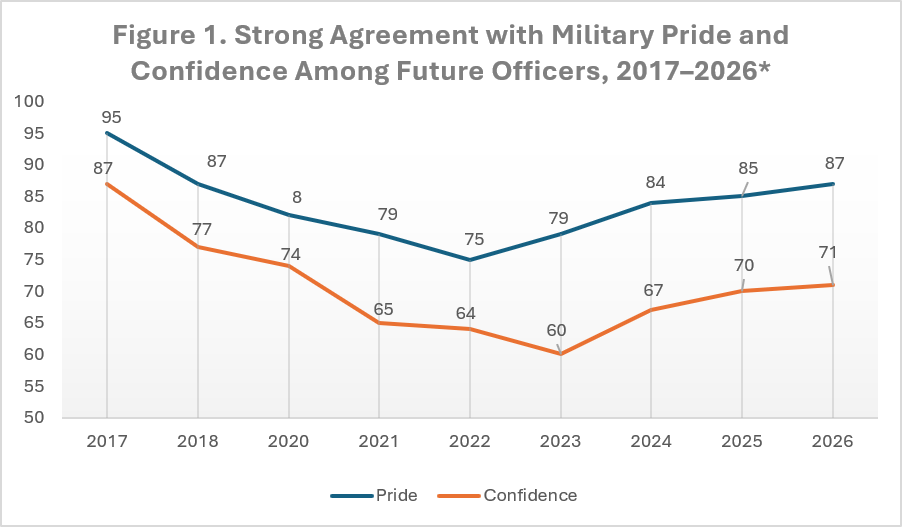
Here, we take a different approach by examining only those respondents who “strongly” agreed with that statement. We also focus only on ROTC and Military Academy cadets because they represent the nation’s future officers. This approach allows us to explore whether the intensity of military pride and confidence has changed over time—for those headed into the force.

And a great deal has indeed changed since our first post on this topic. Over the past several years, the U.S. military has found itself at the center of public debate. Questions about diversity initiatives, recruiting challenges, the withdrawal from Afghanistan, the military’s role along the southern border, and its place in an increasingly polarized political environment have generated considerable discussion. During this period, the United States has experienced changes in presidential administrations and commanders-in-chief. We were interested in whether these broader changes were accompanied by changes in the attitudes of the young men and women preparing to become military officers

* Values represent the percentage of ROTC and academy cadets selecting “Agree Strongly” to two survey statements: (1) “I am proud of the men and women who serve in the military” and (2) “I have confidence in the ability of our military to perform well in wartime.”

As Figure 1 illustrates, the percentage of cadets who strongly agreed that they were proud of those who serve and who expressed strong confidence in the military’s wartime performance declined during the early 2020s before showing signs of recovery in the most recent surveys.

Although the proportion of cadets selecting “Agree Strongly” fluctuated over time, the overwhelming majority continued to express pride in those who serve and confidence in the military’s ability to perform in wartime. Our broader conclusion remains unchanged: support among future officers has remained consistently high, even as the intensity of those attitudes has varied modestly over time.

The trends presented here raise interesting questions but do not identify their causes. Changes in presidential administrations, international conflicts, military operations, recruiting trends, and public discourse may all play a role in shaping attitudes toward military service. Understanding which factors matter most remains an important question for future research.

Do Veterans Feel Valued in 2025?

Last Veterans Day, we explored the many ways to be a veteran. Our research found clear differences in how connected young people are to the military. Nearly one in five academy cadets (19%) and ROTC cadets (20%) came from military families—almost double the share of civilian students (11%). Meanwhile, only 4% of civilians were veterans themselves, compared to 9% of academy cadets and 11% of ROTC cadets.

That’s a reminder that the next generation of officers and leaders often has deep family or personal ties to service. But how do those who have already served—the young veterans now in college or training—feel about how society views them? Do they think Americans truly appreciate their service?

Back on Memorial Day, our data showed that 55.8% of young people believed Americans appreciate veterans’ sacrifices. Yet, cadets—especially those at the academies—were less convinced that the public understood their work. Now, with new data from 4,307 respondents, we can take a closer look at veterans’ own perspectives.

Roughly 9% (360) identified as having prior military service—whether active duty, reserves, or National Guard. When asked whether “most members of civilian society have a great deal of respect for the military,” 82% of veterans agreed, along with 80% of civilians (Table 1). But when the question shifted to understanding—“The American people understand the sacrifices made by those who serve in the U.S. military”—agreement dropped: 61% of veterans versus 57% of civilians said yes. Even so, that small gap was statistically meaningful (p<.003).

 VeteransCivilians
Most members of civilian society have a great deal of respect for the military.  82.1%  79.6%
The American people understand the sacrifices made by the people who serve in the U.S. military.  61.4%  57.1%

Table 1. Percent Agreement that Americans Respect and Understand the Sacrifices of Service Members

The data show something subtle but powerful: Young veterans feel respected—but they also sense a gap in understanding. They believe the average American appreciates their service but doesn’t fully grasp what military life demands—the long deployments, transitions home or to another forward deployment, long working at home hours, and physical, emotional, social and psychological tolls associated with military life. That disconnect may not stem from apathy but from distance: only a small share of young Americans today personally know someone who serves (Pew Research Center 2011).

Sociologists and other scholars often call this the civil–military gap—the social distance between those who serve and those who do not (Feaver and Kohn 2001). Our findings suggest that while respect remains high, understanding remains thinner. That’s an important distinction for educators, policymakers, and communities trying to bridge the divide.

So, this Veterans Day, it’s worth asking:
Respect is clear—but are we taking the time to understand?

References

Feaver, Peter and Melvin Kohn. 2001. Soldiers and Civilians.  Cambridge, Massachusetts: MIT Press.

Pew Research Center. 2011. The Military-Civilian Gap: Fewer Family Connections. Research Report. Accessed from https://www.pewresearch.org/social-trends/2011/11/23/the-military-civilian-gap-fewer-family-connections/?utm_source=chatgpt.com.

The Many Shades of Veteran, Part 1

Veterans Day is set aside each year to recognize all people who have served honorably in active duty military. While our data focuses on cadets, we have created a unique window to the many ways that people can be a veteran in today’s society. And, it makes a difference. Being a veteran gives you access to any number of services in society. Organizations like USAA provide insurance and other services not only to military personnel but also veterans and their families. USAA commercials with famous football player Rob Gronkowski (New England Patriots and Tampa Bay Buccaneers) comically shows him trying to become a member of USAA only to be turned away each time because he has no ties to the military.

Our data show quite a variety of connections to the military. In this post, we focus on the connection between current military status (cadet or not), coming from a family in which at least one parent served (Brat), and previous military status (veteran). Does being a cadet relate to military status in other ways, like being from a military family and previous military experience? Morten Ender’s edited book, Military Brats and Other Global Nomads does a good job demonstrating the ties among military personnel and their families. Veterans produce veterans just like preachers produce preachers, though some rebel against the identity (see Preacher’s Kid (PK) Syndrome). Figure 1 demonstrates the many ways that military ties can occur among people in our samples.

Figure 1. Diagram Outlining the Ways that People can be Connected to the Military

For this post, we utilize some of our data from 2017 to 2024 (N=3540). Here, we see a good percent of our cadets come from military families (Table 1). Nineteen percent of our academy cadets and 20 percent of ROTC cadets come from military families compared to only 11 percent of civilian students. While a much lower percent of our sample actually served in the military, the divide in levels of service among civilians and military cadets is similar: nine and 11 percent of cadets, respectively, had military service prior to becoming a cadet. About four percent of civilian students had prior military service.

Academy CadetROTC CadetCivilian
Military Brat18.7%20.2%11.2%
Veteran (prior service)8.8%11.4%3.6%
Table 1. Distribution of Veteran or Military Family Status by Current Military Status

We will continue this analyses in future posts, to answer the question: does additional military exposure impact attitudes toward military service in a positive or negative way, if at all? Like PK syndrome, additional exposure could create a negative sentiment toward the military and its mission. Alternatively, it could strengthen their attitudes, at least among those who are willing to stay in service.

We wish a happy veterans day to all of those serving in the military now and who have honorably served their country in the past.