In a 2022 Veterans Day post, we reported that support for those who serve was overwhelmingly positive. Among college students, nearly all respondents agreed, either strongly or somewhat, that they are proud of the men and women who serve in the military. That analysis focused on overall agreement.
Here, we take a different approach by examining only those respondents who “strongly” agreed with that statement. We also focus only on ROTC and Military Academy cadets because they represent the nation’s future officers. This approach allows us to explore whether the intensity of military pride and confidence has changed over time—for those headed into the force.
And a great deal has indeed changed since our first post on this topic. Over the past several years, the U.S. military has found itself at the center of public debate. Questions about diversity initiatives, recruiting challenges, the withdrawal from Afghanistan, the military’s role along the southern border, and its place in an increasingly polarized political environment have generated considerable discussion. During this period, the United States has experienced changes in presidential administrations and commanders-in-chief. We were interested in whether these broader changes were accompanied by changes in the attitudes of the young men and women preparing to become military officers
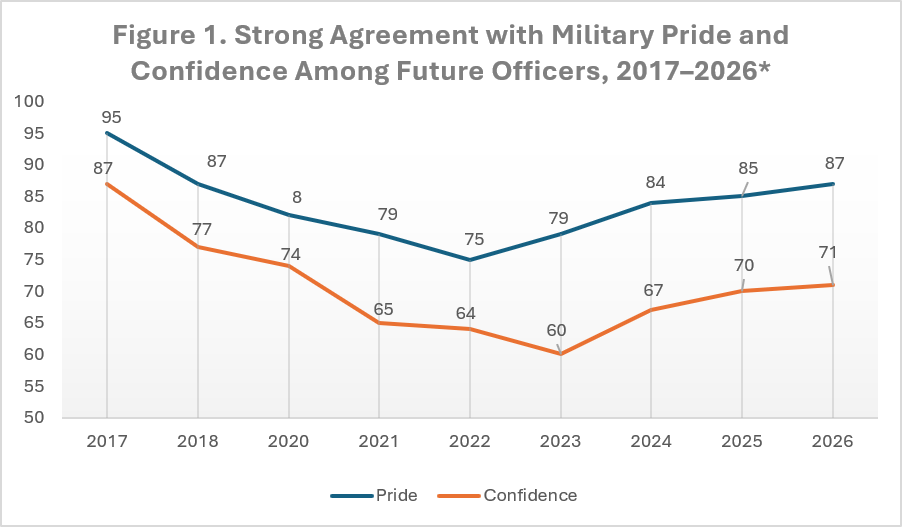
* Values represent the percentage of ROTC and academy cadets selecting “Agree Strongly” to two survey statements: (1) “I am proud of the men and women who serve in the military” and (2) “I have confidence in the ability of our military to perform well in wartime.”
As Figure 1 illustrates, the percentage of cadets who strongly agreed that they were proud of those who serve and who expressed strong confidence in the military’s wartime performance declined during the early 2020s before showing signs of recovery in the most recent surveys.
Although the proportion of cadets selecting “Agree Strongly” fluctuated over time, the overwhelming majority continued to express pride in those who serve and confidence in the military’s ability to perform in wartime. Our broader conclusion remains unchanged: support among future officers has remained consistently high, even as the intensity of those attitudes has varied modestly over time.
The trends presented here raise interesting questions but do not identify their causes. Changes in presidential administrations, international conflicts, military operations, recruiting trends, and public discourse may all play a role in shaping attitudes toward military service. Understanding which factors matter most remains an important question for future research.
 genzmilitary