Today, the New York Times and other news outlets reported that the U.S. military announced that its withdrawal of troops from Iraq is complete, closing the latest chapter in more than two decades of American military involvement in the country. U.S. forces invaded Iraq in 2003 and withdrew in 2011, before returning in 2014 as part of the campaign against ISIS. The current withdrawal follows an agreement between the United States and Iraq to wind down that mission.
For us at GenZMilitary, today’s news also provides an opportunity to look backward. We have been studying young Americans’ attitudes toward this and other wars and conflicts since the years immediately following 9/11. In a 2006 article in Armed Forces & Society, David Rohall, Morten Ender, and Michael Matthews compared West Point cadets, ROTC cadets, and civilian college students. We found that the military-affiliated students were more supportive of military action in Iraq and Afghanistan than civilian students, although much of that difference could be explained by gender and political identification.
We continued following these attitudes as the wars continued. That work eventually included a chapter examining trends and variations in American undergraduates’ attitudes toward the wars in Iraq and Afghanistan in The Routledge Handbook of War and Society: Iraq and Afghanistan (Ender, Rohall, and Matthews 2010).
With the latest U.S. military mission in Iraq now ending, we returned to those surveys to ask a simple question: What happened to young Americans’ support for military action in Iraq over time?
What Our Surveys Found
The figure below shows the percentage of civilian students and military-affiliated students (ROTC and service academy cadets) who favored military action, including the use of ground troops, in Iraq between 2002 and 2016.
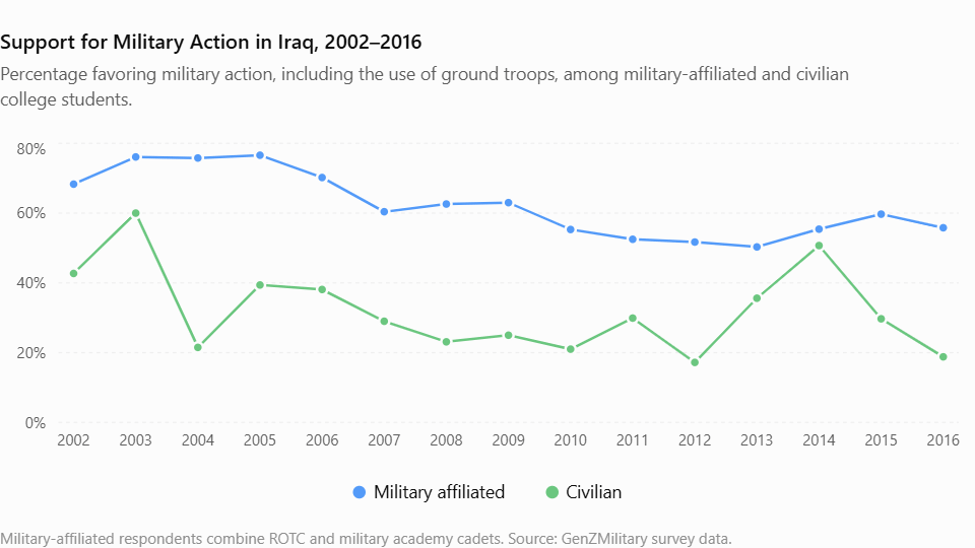
Two patterns stand out.
First, support for military action was consistently higher among students affiliated with the military. During the early years of the Iraq War, roughly seven in ten or more military-affiliated students favored military action. Civilian support was substantially lower.
Second, support among military-affiliated students was remarkably persistent. It declined from more than 75 percent during the early years to around 50–60 percent during much of the later period, but a majority generally continued to favor military action. Civilian opinion was not only lower but considerably more variable, frequently falling below 30 percent.
There is one particularly interesting exception. In 2014, civilian support jumped to 50.7 percent, nearly matching the 55.4 percent support among military-affiliated students. That year coincided with the rapid rise of ISIS in Iraq and the return of U.S. military operations to the country. The survey cannot establish that those events caused the increase, but the timing makes the convergence particularly noteworthy.
Looking Back
More than two decades after the 2003 invasion, today’s withdrawal provides a natural point to revisit the attitudes that accompanied America’s long involvement in Iraq. Our surveys show that support for military action was never static. It changed as events changed and as successive cohorts of young adults entered college.
These descriptive data cannot tell us by themselves why that difference existed. Our earlier research suggests that some of the apparent military-civilian divide reflects differences in the characteristics of the people who select into military and civilian institutions—including gender and political identification—rather than simply an effect of military culture itself.
As the last American troops leave Iraq, these surveys provide a record of something that can easily be lost when we look back at a war decades later: what young Americans—both those preparing to serve and those remaining civilians—thought about the use of military force while the events themselves were still unfolding.
References
Rohall, David E., Morten G. Ender, and Michael D. Matthews. 2006. “The Effects of Military Affiliation, Gender, and Political Ideology on Attitudes toward the Wars in Afghanistan and Iraq.” Armed Forces & Society 33(1): 59–77.
Ender, Morten G., David E. Rohall, and Michael D. Matthews. 2010. “American Undergraduate Attitudes Toward the Wars in Iraq and Afghanistan: Trends and Variations.” Pp. 294–305 in The Routledge Handbook of War and Society: Iraq and Afghanistan, edited by Steven Carlton-Ford and Morten G. Ender. New York: Routledge.

