As the United States continues its military involvement with Iran, public opinion shows that many Americans disapprove of the conflict, although clear majorities are not present. For instance, an AP/NORC poll finds that 39% of Americans somewhat or strongly oppose airstrikes in Iran, while 33% approve. Similarly, in Venezuela, a YouGov analysis shows a narrow margin of opposition: about 45% of Americans oppose U.S. military efforts to overthrow President Nicolás Maduro, compared to 40% who support it.
Across cases, the pattern is consistent: some support exists, but it is cautious, conditional, and often declines as missions expand.
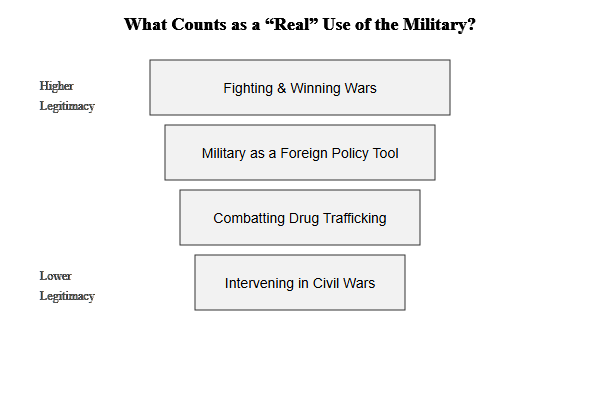
In a previous post, we introduced the idea of a “legitimacy ladder.” This is a way of thinking about how support for military action changes depending on the mission. At the top are traditional war-fighting roles, while at the bottom are more ambiguous or politically complex uses of force. We also see this pattern using survey data from civilian students, ROTC cadets, and military academy cadets collected between 2017 and 2025 (n = 4,412). It includes the percentage of respondents who believe each role of the military is appropriate (combining “very” and “somewhat” responses) displayed by affiliation:
- Fight American Wars
Civilian (90.9%) | ROTC (98.4%) | Academy (97.9%) - Foreign Policy Instrument
Civilian (80.8) | ROTC (92.2%) | Academy (90.3%) - Combat Drug Trafficking
Civilian (74.8%) | ROTC (77.5%) | Academy (74.5%) - Intervene in Civil Wars
Civilian (57.1%) | ROTC (61.5%) | Academy (58.7%)
(All but the final category are statistically significant.)
A Simple Pattern
What stands out is not division, but a clear gradient.
Support is strongest when the military is used for its most traditional role: fighting and winning wars. Among ROTC and academy students, support is nearly unanimous.
Support remains high when the military is described as a tool of foreign policy. But here, we begin to see the first signs of caution, especially among civilians. The sharper shift comes in the final two categories.
When the military is used to combat drug trafficking, support drops into the mid-70 percent range. That is still a majority, but it is no longer overwhelming. These missions begin to blur the line between military force and law enforcement.
Support drops further when it comes to intervening in civil wars. Only about 57–62 percent of respondents see this as appropriate, and differences between civilians and military-affiliated students largely disappear, the only category where those differences are not statistically significant.
In other words, skepticism increases as missions become less clearly tied to national defense.
Connecting the Data to Current Events
This pattern helps make sense of recent public opinion. In Venezuela, Americans were wary from the beginning. Support was limited, and concern about deeper involvement was widespread.
In Iran, that skepticism has become even more pronounced. While Americans may support broader strategic goals, they are far less certain about the use of military force to achieve them.
Taken Together
Americans, especially younger Americans, do not reject military force. But they do place limits on it. Even in the least-supported category, a majority of respondents still express some level of approval, more than the level of support seen in current public polling on Venezuela and Iran. This suggests an important distinction between general attitudes and specific conflicts.
It may be that, in theory, people are open to these types of missions, but in practice, support depends on whether political leaders clearly define the goals, limits, and connection to national defense. More research is needed that examines support for the political leadership at the time of a particular intervention. That may be the key to building broader support, particularly among younger Americans.



 genzmilitary