Guns. The term alone generates deep sentiments and emotions. The topic of gun regulation in the United States is one of the most politically contested (Campbell, 2021). On one end of the spectrum is the literal interpretation of the Second Amendment of the U.S. Constitution stating the U.S. will have “a well regulated Militia, being necessary to the security of a free State, the right of the people to keep and bear Arms, shall not be infringed.” On the other end, there is an ongoing social movement seeking various forms of regulating firearms, such as assault weapons that are “semiautomatic”—feeding the barrel continuously and unremittingly. As of late 2023, survey estimates found that just under half of U.S. households have a gun; while just over half of Americans favored more strict gun laws (Jones, 2023).
But what about generational differences? Most Millennials (mid-20’s to 40) have lined up with libertarian views on a host of issues including individual and civil-related rights for the past forty years including not regulating guns (see Twenge, 2023). Still, slightly more 18- to 29-year-olds favor more strict gun laws in the United States (almost 2/3rds) compared to older Americans (Schaeffer, 2023). But what about within group differences including cadets committed to the profession of arms compared to undergraduate civilian peers? Are they more or less gun law restrictive?
We have been examining attitudes toward a variety of socio-political issues for 22 years. Among them are abortion, capital punishment, free college tuition, prayer in public schools, and social inequity, among other topics including guns. In the trend chart below, we show attitudes toward agreements with the statement “There should be stringent control of the sale of handguns.” While overall the trend lines are moving toward less agreement, the topic is volatile at best. Further, our three groups show consistent agreement as in our previous of studies of other socio-political topics such on the role of national defense (Ender, Rohall, and Matthews, 2014). Further, the groups tend to reflect the American population for their generation overall—more strident than older generations. Yet, within group differences show they too are split on the issue of handgun regulation. Do note that our question deals with a more extreme form of gun regulation—handguns sales. Our question is not on an assault weapon ban where more of the politics and polling are focused. What is your attitude toward gun regulation? Next, has their attitude toward handguns changed over time? Is it influenced by mass shootings that easily identifiable with names like Columbine, Luby’s, Charleston, Sandy Hook, Virginia Tech, Buffalo, and Uvalde (Lawler and Rummler, 2023)? There is an overall downward slope into the last decade, but some increase this decade, notably more so for civilians.
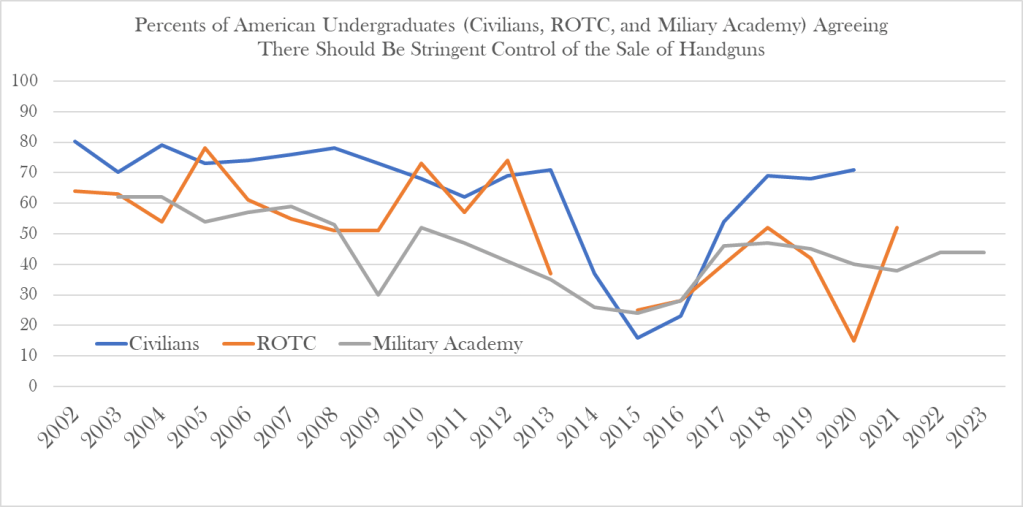
NOTE: Question not asked of military academy cadets in 2002, ROTC cadets in 2014 and after 2021, and civilian undergraduates after 2020.
Works Cited
Campbell, Donald J. (2021). Guns in America: Examining the Facts (Contemporary Debates). Santa Barbara, CA: ABC-CLIO and Rienner.
Ender, Morten G.,David E. Rohall, and Michael D. Matthews.(2014). The Millennial Generation and National Defense: Attitudes of Future Military and Civilian Leaders. Basingstoke and NY: Palgrave.
Jones, Jeffrey M. (2023). “Majority in U.S. Continues to Favor Stricker Gun Laws,” Gallup.com (October 31). Available at: https://news.gallup.com/poll/513623/majority-continues-favor-stricter-gun-laws.aspx.
Lawler, Dave, and Orien Rummler. (2023). “The Deadliest Mass Shooting in Modern History,” Axios (October 26).
Schaeffer, Katherine. (2023). “Key Facts About Americans and Guns,” Pew Research Center (September 13).
Twenge, Jean M. (2023). Generations: The Real Differences Between Gen Z, Millennials, Gen X, Boomers, and Silents—and What They Mean for America’s Future. NY: Atria Books, p. 313.
 genzmilitary